
A Lyapunov exponent captures the average exponential rate at which nearby trajectories in a dynamical system diverge or converge, revealing whether the system behaves predictably or chaotically.
To calculate Lyapunov exponents in COPASI, go to the Task branch in the tree view and select Lyapunov Exponents. This will open the relevant widget. The first field, Number of Exponents, allows you to choose how many Lyapunov exponents to calculate. The value should be between one and the total number of independent variables in your system (i.e., the number of non-constant species minus the number of mass conservation relations). If you enter a number greater than allowed, COPASI will warn you and display the maximum possible value.
While calculating Lyapunov exponents, COPASI performs a time course simulation.
If your model has a long transient phase, you may want to exclude the initial
segment from the exponent calculation. You can set the time at which to start
averaging the Lyapunov exponents using the field labeled
start averaging after t=.
There is a checkbox labeled calculate Divergence that, when enabled, tells COPASI to compute the average divergence. The divergence is calculated as the average of the trace of the Jacobian (see Lyapunov Exponents Calculation).
Details about the calculation method and the meaning of parameters like Orthonormalization interval and Overall time are explained in the Lyapunov Exponents Calculation section.
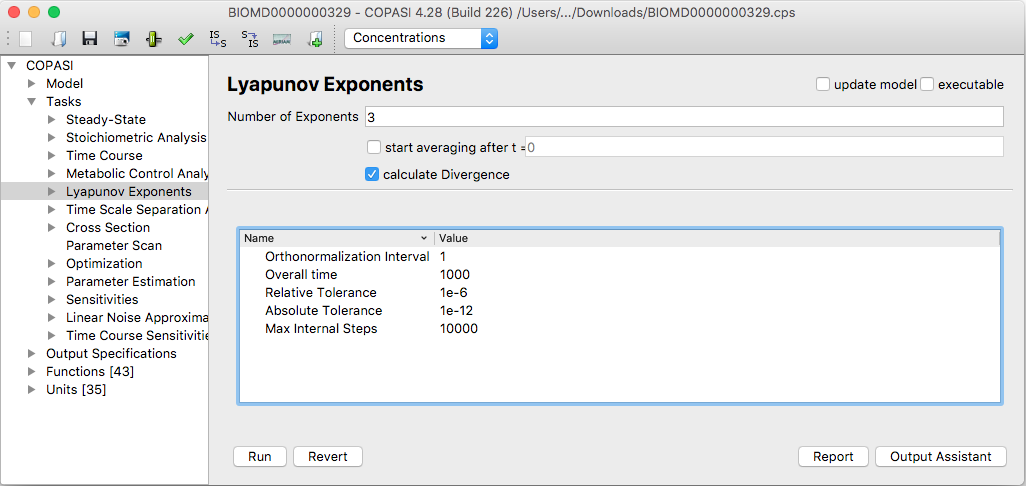 |
| Lyapunov Task Dialog |
After you click the Run button, COPASI will begin the time course simulation to calculate the Lyapunov exponents. When the calculation is complete, COPASI will automatically switch to the Result window. Here, the calculated Lyapunov exponents are displayed in a table, with their sum shown below the table. If you chose to calculate the divergence, this value will also appear beneath the sum of the exponents.
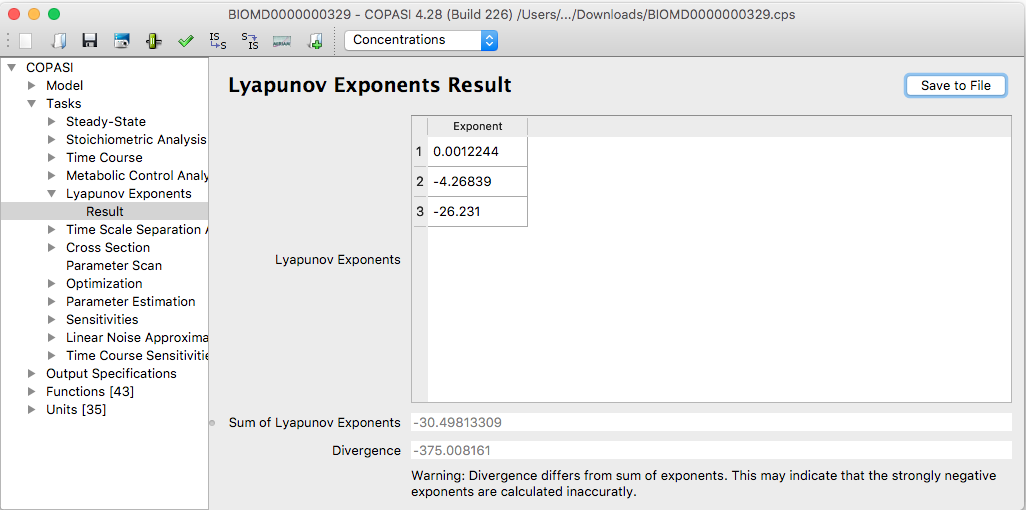 |
| Results for the Lyapunov Exponent Calculation |
If you requested COPASI to calculate all possible Lyapunov exponents (i.e., as many as there are independent variables in the model), the sum of the exponents and the divergence should match; if they do not, COPASI will display a warning. This warning is only shown when all exponents have been calculated, as a difference between the sum and divergence is expected otherwise.