
A global quantity (sometimes called a global parameter) can represent nearly anything in your model. Most commonly, a global quantity is used as a shared parameter for several reactions, but you can use it to represent any variable or process that is not specifically located within a compartment.
In the model tree, you will find the Global Quantities branch just below the Reactions branch. Selecting this branch opens a table displaying all global quantities currently defined in your model. When you create a new model, this table—like the others—begins empty (see image below).
The table contains eight columns: Index and Name should be familiar from previous sections. The third column shows the type of each global quantity, which can be one of three options:
The fourth column shows the unit, while the fifth and six columns show the initial and transient values of the global quantity. the seventh column displays the rate of change. The final two columns present the mathematical expressions, when required, for types other than fixed.
As with other model elements, you can add a global quantity in several ways. The simplest method is to enter a name directly into an empty cell in the Name column.
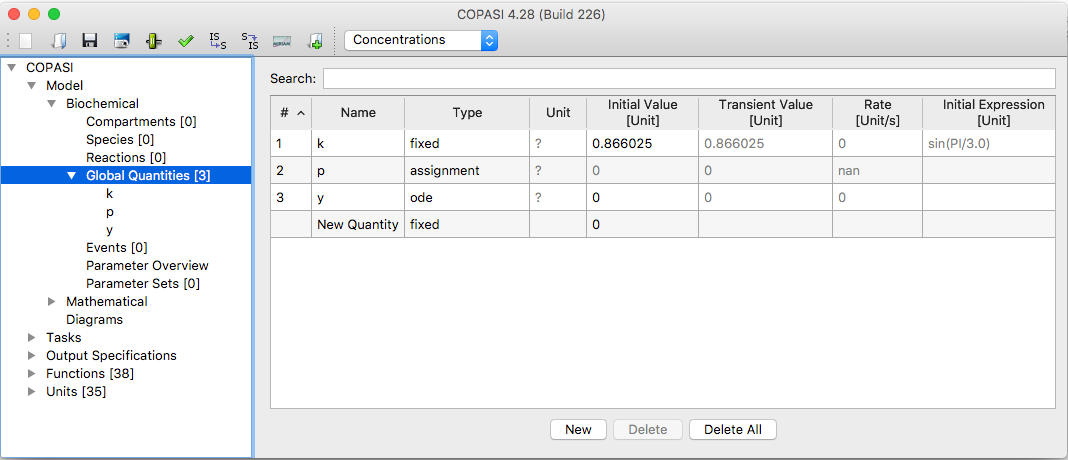 |
| Global Quantities Table with 3 Entries |
If you click on the name of a global quantity in the tree on the left or double click on a row of the table only the information correlated with the chosen global quantity will be displayed.
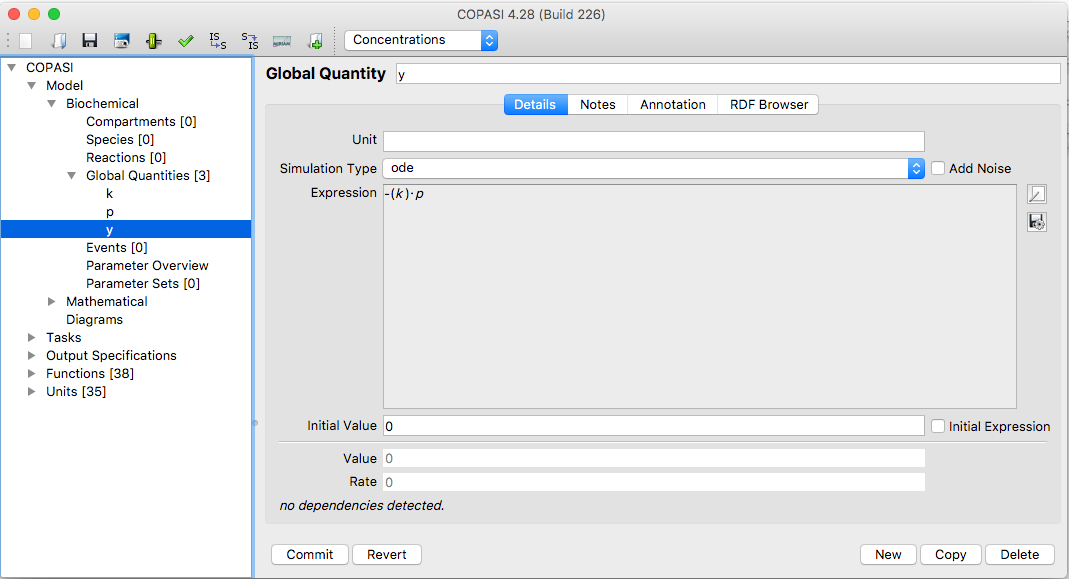 |
| Global Quantity User Interface with ODE Rrule |
In order to specify whether a parameter has a constant value or the value is calculated on the fly according to a mathematical expression, the drop down list called Simulation Type should be used.
The drop down list contains three following entries:
| Name | Description |
|---|---|
| fixed | the value of the parameter is constant (which corresponds to the given initial value) |
| assignment | the value of the parameter is determined by evaluating the given mathematical expression |
| ode | the rate of change of the parameters value is determined by an ordinary differential equation |
To have a parameter’s value determined by a mathematical expression, choose assignment from the Simulation Type drop-down menu. This enables a text field where you can enter the mathematical expression used to calculate the parameter’s value. Similarly, if you want the rate of change of the parameter to be defined by an ordinary differential equation (ODE), select ode from the drop-down menu.
You can specify not only a parameter’s value over time, but also its initial value, using a mathematical expression. To do this, check the box labeled Use Initial Expression. Note that an initial expression can only be defined if the Simulation Type is set to either fixed or ode. If the Simulation Type is assignment, the assignment itself automatically provides the initial value, and no separate initial expression is needed.
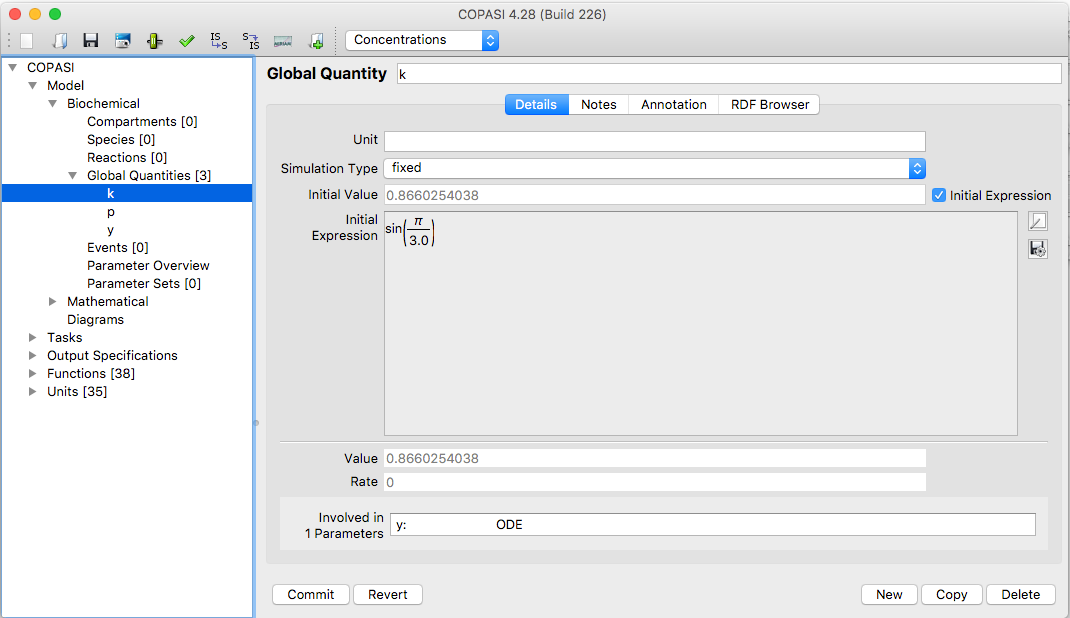 |
| Global Quantity Widget with an Initial Assignment |
The mathematical expressions used for rules and initial assignments can include the same elements available when defining user-defined functions. For a detailed description of these elements, see the User Defined Functions section.
When creating mathematical expressions, there is a subtle difference between those used for rules and those used for initial assignments. A rule expression may reference the current (transient) values of other model entities, whereas an initial assignment may reference only the initial values of those entities.
Although COPASI is not designed to build models directly from systems of
ordinary differential equations (ODEs), you can represent a system of ODEs
within COPASI by defining a set of global parameters of type ode.